
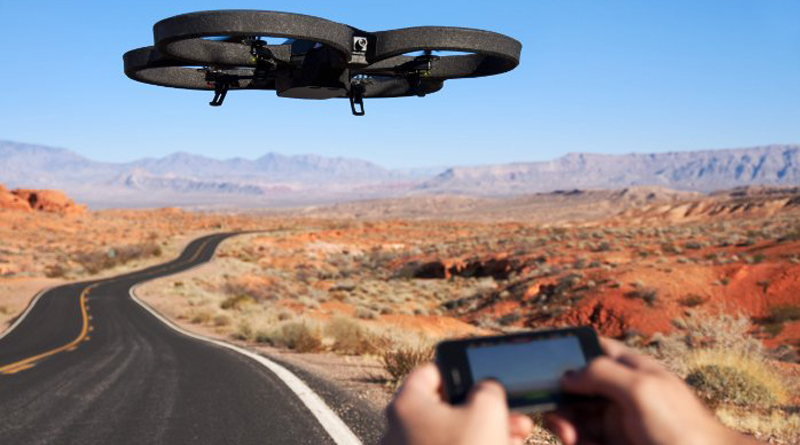
En quelques décennies, les connaissances de pointe sont devenues une simple commodité. Ainsi pour toute entreprise innovante, il est devenu plus sûr, moins cher, mais surtout beaucoup plus rapide d’assembler les bonnes briques du puzzle (connaissances, technologies ou talents), en allant les chercher à l’extérieur afin de mettre sur le marché des produits supérieurs. L’open Innovation est devenue une réalité. C’est ce qu’illustre le cas Parrot, le leader français des kits main-libre pour l’automobile qui est devenu, en quelques années, le leader sur le marché des drones.
Un virage stratégique suprenant
« Il faut qu’elle vole! Notre voiture télécommandée Wi-Fi doit voler! » C’est exactement à cet instant qu’Henri Seydoux a eu la révelation. L’idée qui allait devenir l’un de ses défis les plus audacieux, mais aussi les plus passionnants. En 2007, Parrot, le leader des kits main-libre pour l’automobile, travaillait déjà sur un projet de voiture télécommandée Wi-Fi, destinée à diversifier l’activité de l’entreprise. Tout était prêt pour passer en production. Mais Henri Seydoux décida d’annuler le projet, car il ne le trouvait pas assez ambitieux, jusqu’à ce qu’il ait l’idée de transformer la voiture en drone.
L’ADN de l’entrepreneur forge la culture de toute l’entreprise
Dans une société classique, le projet de voiture télécommandée aurait été oublié. Mais Parrot n’est pas une entreprise comme les autres. Et Henri Seydoux n’est pas un PDG comme les autres. A l’instar de Steve Jobs, il est un entrepreneur autodidacte, visionnaire et atypique. Lui-même se définit comme un rat de bibliothèque, parce que tout ce qu’il sait, il l’a appris de son propre chef. Cette composante autodidacte est très importante: rechercher en permanence les connaissances qui lui manquent à l’extérieur fait partie son ADN, et de sa culture. Comme de celle de Parrot. En outre, parce qu’il est passionné d’open-source, il sait comment assembler rapidement les meilleures technologies et les meilleurs talents pour être le premier sur le marché avec des produits innovants et supérieurs.
Le timing, le principal challenge
Les défis à relever dans le cadre du projet de drone étaient nombreux, et Henri Seydoux savait que Parrot ne pourrait pas les accomplir seul. Comme souvent, le timing était le principal enjeu. Il s’agissait de sortir le produit avant les autres. Le problème? De nombreuses briques de connaissances n’étaient pas disponibles en interne: aéronautique, mécanique, caméra vidéo, algorithmes de contrôle, etc. Comment s’organiser pour avoir in fine, le time-to-market le plus court possible?
Mobiliser un expert externe… même s’il est très jeune
Alors qu’il était étudiant en ingénierie à l’Institut National Polytechnique de Grenoble (INPG), Pascal Zunino bricolait déjà ses propres drones, dans son garage, depuis environ cinq ans. Remporter le prix du prestigieux concours de l’innovation de l’ONERA / DGA lui a donné beaucoup de visibilité. C’est ainsi qu’Henri Seydoux a trouvé l’expert qui allait lui faire gagner un temps précieux dans le développement de son idée.
Une équipe commando pour aller vite
Au début de l’année 2007, Parrot a assemblé une nouvelle équipe : l’équipe commando qui serait en charge de faire voler la voiture télécommandée. Le jeune Pascal Zunino l’a rejointe en tant que consultant externe. Il a notamment aidé Parrot à développer divers aspects clés du drone: design des hélices, système de contrôle, algorithmes de stabilisation, télémètre ultrasonique, banc de tests, etc. Alors que la partie interne de l’équipe s’est focalisée sur la vidéo, Pascal Zunino était, lui, centré sur vol. Comme Tony Fadell dans le projet iPod d’Apple, Pascal Zunino a joué un rôle essentiel, alors qu’il était externe à l’entreprise. Cette équipe commando a fonctionné comme une start-up au sein de Parrot. Le mot d’ordre était secret et efficacité.
Un lancement mondial avec un timing presque parfait
L’AR.Drone a été officiellement lancé lors du Consumer Electronics Show 2010 (CES) de Las Vegas – trois ans après la révélationqu’avait eur Henri Seydoux. Il fut, cette année-là, la star du CES. Ce fut le premier drone quadricoptère Wi-Fi à réalité augmentée. Le timing était parfait pour surfer sur la vague du maintenant célèbre hélicoptère miniature PicooZ. En fait, Parrot a non seulement attrapé la vague, mais il l’a prolongée, en convergeant avec celle des vidéos d’action (GoPro). L’AR.Drone est arrivé sur le marché quelques mois après le CES, avec un lancement mondial en août 2010, d’abord depuis Hong Kong et la France, puis dans le reste du monde. Cette première version du drone fut un grand succès: 120 000 AR.Drone furent écoulés en l’espace de cinq mois.
Bien que, selon les bonnes pratiques de gestion de l’innovation, le projet drone aurait dû être tué à plusieurs reprises, il a survécu. Quatre ans après le lancement de l’AR.Drone au CES, Parrot a sorti deux nouvelles générations et a fait l’acquisition d’autres entreprises de drones pour développer des applications professionnelles. Environ 50% du chiffre d’affaires de l’entreprise sont aujourd’hui générés par les ventes de drones.
Les clés de la diversification de Parrot
Parrot a réalisé avec succès sa diversification avec un time-to-market très court. Cela a été rendu possible car Parrot a su rapidement assembler les pièces du puzzle, la plupart d’entre elles venant de l’extérieur de l’entreprise. Ce succès est en grande partie liée à la personnalité d’Henri Seydoux: n’étant pas ingénieur de formation, il sait poser les bonnes questions et a le reflexe de rechercher des réponses à l’extérieur, plutôt que d’essayer de résoudre les problèmes par lui-même. C’est ce qui fait de lui un exemple en matière d’open innovation.
Albert Meige, CEO & Enchanteur, Presans.
***
*
Cette chronique a été initialement publiée sur le site de Harvard Business Review France.
Retrouvez HBR France sur LinkedIn.
Cette étude de cas est extraite du livre « Innovation Intelligence » (2015). Pour la réaliser, nous avons interviewé les principales parties prenantes du projet drone : Henri Seydoux (cofondateur et CEO de Parrot), Guillaume Pinto (Chief Technology Officer), François Callou (AR.Drone Project Leader), et Pascal Zunino (cofondateur et CEO de Novadem, et consultant pour Parrot).
In this book, the authors provide an up-to-date overview of recent, disruptive trends that induce changes in the way large companies deal with innovation. Special attention is given to the impact of the digital wave. The book was written after approximately 40 interviews with the Chief Technology Officers and Chief Innovation Officers of large international companies such as Airbus Group, Danone, TOTAL, and Faurecia, among others.
From decision to action
The Conciergerie helps you engage on demand top level experts for industrial innovation
Rétroliens/Pings